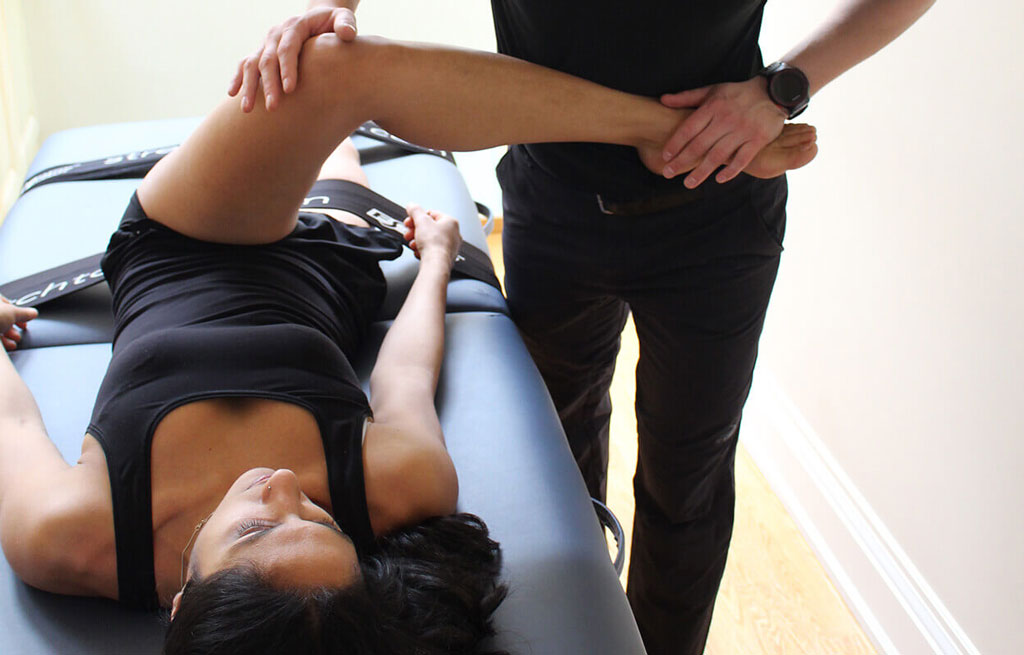
Think of the web of connective tissue wrapped around every muscle, organ and nerve in your body. That is your fascia — and when it tightens, it pulls on everything it touches. MyoFascial Stretch Therapy is a hands-on approach that lengthens and releases those deeper layers, rather than simply working on the surface muscles. Because fascia can hold onto tension and even the memory of old injuries, releasing it often settles the nervous system at the same time.
Why it is different to ordinary stretching
Most of us were taught to stretch by holding a position and pushing through discomfort. That approach has its limits — it can be unpleasant, and it rarely reaches the layers where chronic tightness actually lives. MyoFascial Stretch Therapy is different: you lie on a specialised stretch table while I use supported, rhythmic movement to guide the body into deep release. The technique is designed to be pain-free, and most people find it genuinely relaxing rather than something to grit their teeth through.
The seven key benefits
- Improved flexibility and range of movement
- Rapid relief from pain and muscle tension
- Loosening of stiffness and general soreness
- Smoother, more natural body function
- A noticeable lift in energy
- Better quality sleep
- An overall sense of ease and wellbeing
It reaches what you cannot reach yourself
Fascial lines run continuously through the body — a restriction in one area can create symptoms somewhere else entirely. That is why a physiotherapist always looks at the whole map rather than the single dot: a tight calf may be contributing to a headache if the fascial line between them is under strain. Working along these lines lets me access areas that are almost impossible to reach with self-stretching, including deep joint structures where a surprising amount of tightness can accumulate.
Treating the source, not just the symptom
I often say that a knee problem is not always a knee problem. If we only ever treat where it hurts, we can miss the reason it hurts. MyoFascial Stretch Therapy follows the tension back along the fascial lines to its origin, so we are not just switching off the alarm — we are addressing what set it off.
Good posture follows naturally
Prolonged sitting, repetitive work and old habits all leave their mark on fascia, and over time that shows up as posture. As the restrictive bands release and the body rebalances, standing and moving become easier and more aligned — not because you are forcing yourself upright, but because your body is no longer being pulled out of shape.
A more enjoyable way to move well
The old "no pain, no gain" idea does more harm than good when it comes to stretching. When the body is braced and tense, it resists; when it is relaxed, tissue softens and lengthens far more easily. MyoFascial Stretch Therapy works with the body instead of against it, which is why most clients describe the session as soothing rather than strenuous — and why it is suitable for everyone from serious athletes to people who have simply forgotten what it feels like to move without restriction.
Why it is worth exploring
Greater ease of movement, less pain, better posture and a calmer nervous system are not small things — they change how your day feels. If you have been living with stubborn tightness or discomfort that has not responded to conventional stretching, this therapy may be the missing piece. The best way to find out is to book a session and experience it for yourself.